At a library sale a number of years ago I came across a collection of essays by Henry David Thoreau called Autumn. I picked up a whole bagful of books for only a dollar, so I didn’t take a very close look at it until I got home. When I did, though, I discovered something I had never seen before: several of the pages were uncut so that you couldn’t read what was inside. Here’s a picture of what I found:

I cut a few of the pages (delightful—like unpacking a gift!), but then I thought … no. The book was originally published in 1892, which means that as of today, June 13, 2018, the book is somewhere around 126 years old—and has NEVER been read. All this book has ever done is sit on someone’s shelf—and I can’t help but wonder how many shelves it has sat on.
Now, being an English teacher, experiences like this immediately launch me into the realm of metaphor, and I couldn’t help but wonder how many people live their lives just like this—sitting timidly on a shelf, unread, unused, unappreciated, waiting for some chance encounter, some outside influence, to awaken what lies dormant within. (The metaphor does break down eventually: our lives are written as we live them, though there is an Author who knows each and every story.) All the same, what a waste, waiting to live rather than choosing to live!
I like to show this book to my graduating seniors on their last day in class. I encourage them to take their lives off the shelf, to cut the pages and dare to show the world what a life—their life!—can be.
But this year I was able to add a twist. In a stack of miscellaneous odds and ends teachers were discarding before the end of the year, I found this old book of Methodist Hymns held together by a rubber band (which I removed so I could show it to you). Here it is:
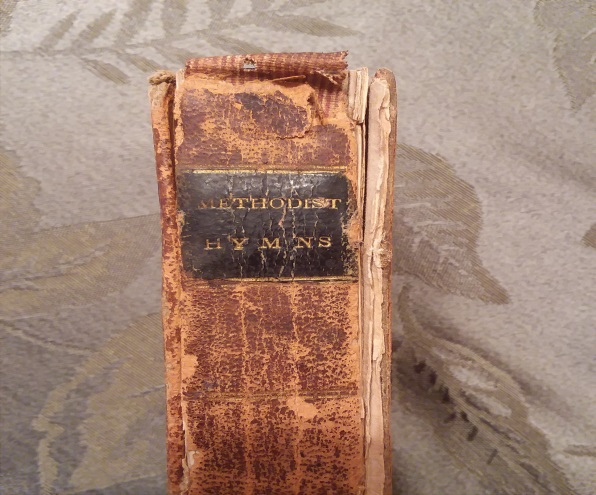
I took off the rubber band to look inside and the cover and several pages fell off in my hands. The title page indicated it had been published in 1832—186 years ago. I was also delighted to find a name inscribed on the flyleaf:
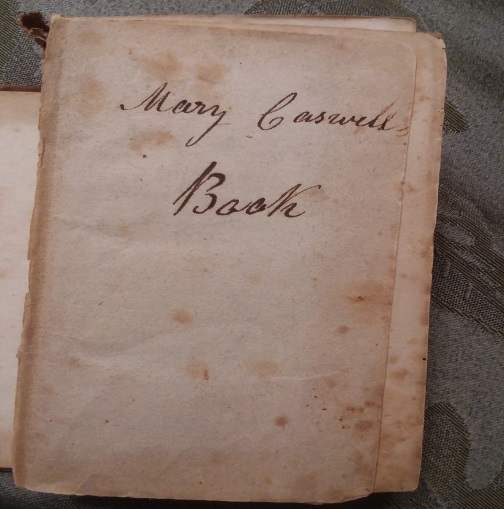
The next half hour or so was sheer bliss! I didn’t know what I’d find, if anything. The hymns are just beautiful (though oddly there is no music, only lyrics). The book was clearly much-used and, at least once upon a time, a valued possession. I couldn’t wait to share it with Sandy (faithful Wesley lover that she is), so I carefully replaced the cover and loose pages and slipped the rubber band back on.
As I said a few moments ago, I am given to seeing metaphors in striking encounters like this. Since I had discovered this hymnal very near the end of the school year, I resolved to include it with my end-of-year senior “sermon.”
Unlike the Thoreau book, this book’s pages are all cut. As best I could tell, the pages had at least been thumbed through. On top of it all, someone (Mary Caswell) had been proud enough of it to write her name in it, forever laying claim to it, despite the fact she certainly died long, long ago. Frankly, the book is worn out. And this was part of the allure! What else might I find? This book belonged to someone! What might I learn about her? Curiosity kept me looking (not to mention the beauty of the hymns themselves).
In the end, if you leave a book, or a life, sitting around unread and unlived it will likely live a pretty long life. If you take enough interest to make it your own, to name it, if you take enough interest to identify yourself with it, you might actually make it something to be admired, even emulated. You may even inspire someone!
As you’re living it now, would you dare leave the book of your life behind, with your name boldly and largely written inside for all to see, as if to say, “This is my book, my life—come, take a look, let me show it to you. It’s taken rather a beating over the years, but I hope you’ll take some solace in these pages and perhaps be inspired to make such a work of your own life.”
Okay, so I doubt Mary Caswell would say any such thing, but all the same, I challenge you. Why not? Why not take your life off the shelf? Why not wear yourself out in service to others? Don’t worry about wearing yourself out, or even losing a few pages here and there—better that than wind up in Mr. Felzer’s Senior English class as an illustration of a life poorly lived.
 Rebuilding the Ruins