Just Such a One as They

This is a very simple post, really. In my morning devotions on Holy Saturday, one of my readings was Psalm 73, and as I read I found myself paraphrasing as I went along. I was enclosed in that tension between Good Friday and Easter Morning, and I felt caught up in the notion that there is no “us” and “them” before the Cross of Christ. I need not a whit less grace than the “proud ones” of the psalm do. Every drop of blood was as necessary for my salvation as for theirs. I truly am just such as one as they.

I felt a kind of urgency, so I hurried to my desk and found myself paraphrasing the whole psalm! There’s nothing especially profound here (except in so far as it’s based on Scripture, so there’s a profound element already built-in!). I don’t offer any commentary, so just read this and pray it in the presence of the One we worship both at the Cross and on the Throne.

PSALM 73

Just Such a One as They

God truly does love His own–all those who have clean hearts.

Even so, I found myself in a slippery place, and I nearly lost my footing because I caught myself envying the proud.  They get ahead so easily.

They are healthy and strong.  Death never enters their thoughts.

To all appearances, they lead a charmed life; they never face misfortune, and so their pride blooms.

They grasp hungrily for all they desire, and their thoughts are nothing but arrogance and cynicism and ridicule.

They even ridicule the God they deny, and their talk spreads over all the earth.  All they do and say is mockery and pride.

All everyone else sees is their beauty and grace.  They deny God, saying–”Obviously, God doesn’t see, for if He did….”

This is life for the ungodly.  They look good and seem to have everything they desire.  And I said to myself, “I have led a good and virtuous life for nothing.  All day every day I suffer weakness and disease and difficulty.”

I could make no sense of this.  It was too confusing for me, and I couldn’t understand how they all seem to do so well for themselves, while I know only suffering and hardship.

And then I went into the sanctuary, into the presence of the Lord, and I saw their end.

You have led every one far out onto thin ice, and they will suddenly and certainly fall through to their destruction.

One day soon their existence will be like a dream when we wake up:  vivid in the moment, but fading to nothing as the sun begins to rise.  They will disappear before Your very eyes.

My heart melted, but my foolishness took form right before my eyes and like an arrow pierced my soul.  I am no better than a beast before You.  In so many ways, I am such a one as they.

And yet….  And yet … I am always with You.  You reach out and take me by the hand. 

You speak wise words to my soul and direct my steps and–when all is said and done, when all around me crumbles into dust–You will receive me into the glory of Your presence.

Whom have I in heaven but You?  You are my one, my only, desire.

Even when my strength fails and my heart beats its last, You will be the strength of my heart and my only inheritance.

Every person who turns from You will themselves be turned from; they will perish in their pride, every one.

But I will cling to You with all that is in me, and until all You have said actually comes to pass, I will dwell in hope.

And until then I will tell everyone I meet of the vast wonders You have accomplished.

Hunger Games

I have a love-hate relationship with fasting. I went through a period several years ago during which I fasted one day a week for about four years. It was a fascinating experience—really, honestly fascinating. Most people don’t believe me when I say that fasting has very little to do with food. It’s true!  Fasting taught me how to say no to myself. It taught me that just because I find a wonderful book, I don’t have to buy it; that just because a Hurricane from Handel’s with peanut butter cups and Heath bars sounds great right now, I’ll survive just fine without it.  Something much more important may be calling from just beyond the craving.

I discovered there are a lot of things I don’t actually need, but that I really, really want all the same.  There is a whole lot all around us that we know full well we don’t need—we just don’t want to do without them.  We see no immediate reason to say no, so we give in. We hunger, and the first thing that comes our way that seems to satisfy the appetite gets indulged in an effort to quash the hunger.

But it turns out there is something I really, really want much deeper inside me—a living, breathing, conversational relationship with Jesus. Fasting taught me that there are all sorts of appetites competing within me for Jesus’ easy, friendly companionship.

So I was feeling restless this afternoon….

About six months ago, I felt a nudging to fast again. I resisted, though, because, well, fasting is rather unpleasant, and besides, if I tried fasting through a school day I honestly thought I’d pass out from all the effort and energy I expend through the day, and I wouldn’t be focused for my students—you get the picture.

Well, a few months later the nudging had still not gone away, so it looked like I was going to have to do something. I decided to fast through lunch twice a week. It not only went well, it went better than expected. I met God there. Sure, I got a little hungry, but the little grumbling was a good reminder of my need for God, that there’s a subterranean hunger running much deeper than the trickle of our little appetites.  And what’s more, it didn’t prove to be a distraction from my students or my teaching.

So school gets out a few weeks ago, and I decide to let the fasting go. Only the nudging kept on. But I answered the nudge and I’ve pretty much kept up with the same plan, with I think one exception. And I had decided earlier this morning to let it go today.

A bit later, I’m sitting out on the patio reading about lectio divina, a practice I heartily enjoy and strongly recommend (check out Ruth Haley Barton’s Sacred Rhythms or look it up on Bible Gateway). I was going to finish the chapter, then get up, change the laundry and get some lunch. Then I thought that, since I missed my regular devotions this morning for the sake of a (very) early elders meeting, I would look up today’s gospel passage (Matthew 16:24-28) and do a little lectio. Your first time through the reading (four times all together), you’re just looking for a word or a phrase to cry out for your attention, when … Bam!  There it is: “let them deny themselves.”

I’m willing to bet right now that you’re hearing God more clearly than I did right then! Fasting? Deny yourself? Get it, Ralph? Believe it or not, though, I went through all four repetitions of the Bible passage before it hit me that God was prompting me to fast after all.

I dug deeper into the reflections. I asked myself, “What are you feeling? What are you afraid of?”

“Well, I don’t have enough now, enough time, enough money, enough energy, enough talent.  I’m afraid!  What if I go ahead and deny myself and You take away even my ‘not enough’?”  I closed the book and looked off into the woods, then looked down and saw a blurb on the back cover:  “Make the decision to leave all outcomes to God.”


As I sat today reading Frank Laubach’s Letters by a Modern Mystic and mulling over my work as a teacher, I read about him praying for the Moro people he was serving.  As he prayed he heard God say, “The most beautiful thing in the universe for you is [the village of] Lanao stretching around this lake at your feet, for it contains the beauty of immense need. You must awaken the hunger there, for until they hunger they cannot be fed.”  Is it possible that the best thing I can do for my students is not to craft snazzier lesson plans, but to search out the means of awakening their hunger for truth, beauty, and goodness?

So it turns out the hunger I’ve been speaking of is not really about food at all!  We are hungry for all sorts of things, and most of the time we have no idea what.  But we are determined to satisfy it, so we clamor after and clutch at anything and everything that presents itself to our appetite.

Fasting, though, takes a small thing like food and uses it to teach us the best way to satisfy that hunger: listen to it.  Let it rumble, and be reminded that indeed, “one does not live by bread alone, but by every word that comes from the mouth of God.” What do I really, truly hunger for?  Why settle for ice cream or cookies, alcohol or sex, shopping or video games when I can revel in the joyful, peace-filled, radiant immediacy of Jesus Himself, God incarnate?


Then Jesus told his disciples, “If any want to become my followers, let them deny themselves and take up their cross and follow me. For those who want to save their life will lose it, and those who lose their life for my sake will find it. For what will it profit them if they gain the whole world but forfeit their life? Or what will they give in return for their life?”

Take Your Life Off the Shelf

At a library sale a number of years ago I came across a collection of essays by Henry David Thoreau called Autumn.  I picked up a whole bagful of books for only a dollar, so I didn’t take a very close look at it until I got home.  When I did, though, I discovered something I had never seen before: several of the pages were uncut so that you couldn’t read what was inside.  Here’s a picture of what I found:

I cut a few of the pages (delightful—like unpacking a gift!), but then I thought … no.  The book was originally published in 1892, which means that as of today, June 13, 2018, the book is somewhere around 126 years old—and has NEVER been read.  All this book has ever done is sit on someone’s shelf—and I can’t help but wonder how many shelves it has sat on.

Now, being an English teacher, experiences like this immediately launch me into the realm of metaphor, and I couldn’t help but wonder how many people live their lives just like this—sitting timidly on a shelf, unread, unused, unappreciated, waiting for some chance encounter, some outside influence, to awaken what lies dormant within.  (The metaphor does break down eventually: our lives are written as we live them, though there is an Author who knows each and every story.)  All the same, what a waste, waiting to live rather than choosing to live!

I like to show this book to my graduating seniors on their last day in class.  I encourage them to take their lives off the shelf, to cut the pages and dare to show the world what a life—their life!—can be.

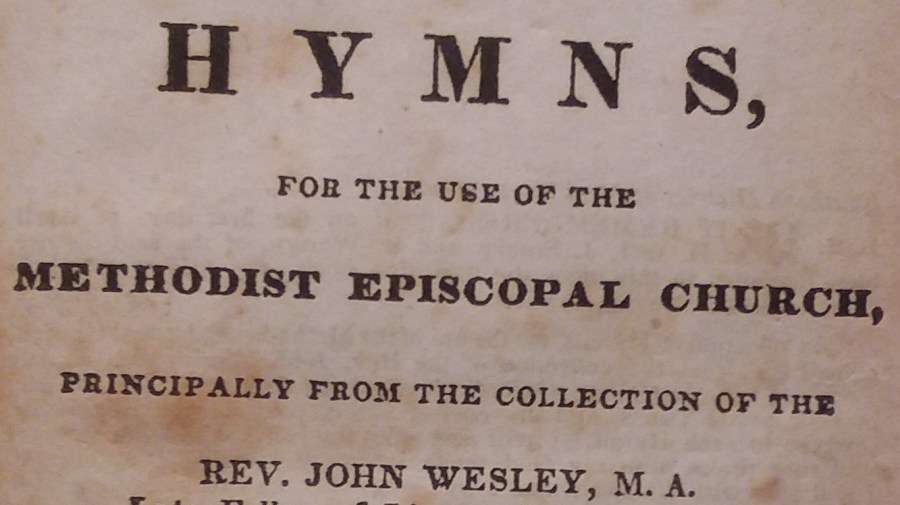
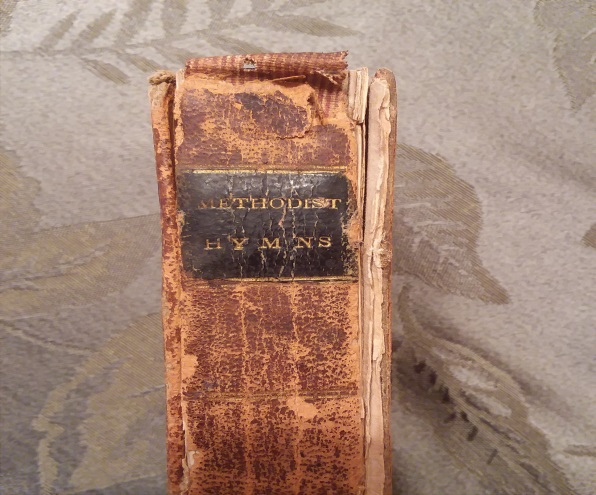
But this year I was able to add a twist.  In a stack of miscellaneous odds and ends teachers were discarding before the end of the year, I found this old book of Methodist Hymns held together by a rubber band (which I removed so I could show it to you).  Here it is:

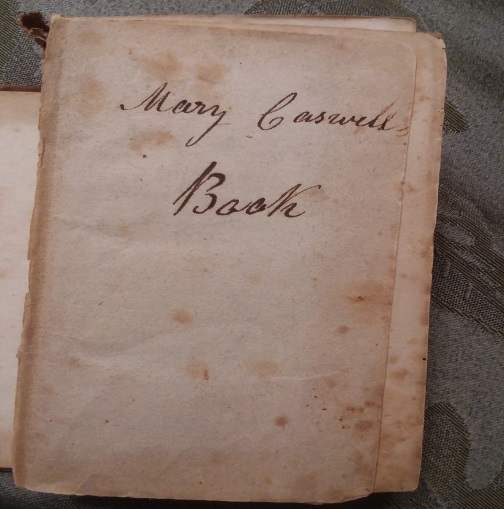
I took off the rubber band to look inside and the cover and several pages fell off in my hands.  The title page indicated it had been published in 1832—186 years ago.  I was also delighted to find a name inscribed on the flyleaf:

The next half hour or so was sheer bliss!  I didn’t know what I’d find, if anything.  The hymns are just beautiful (though oddly there is no music, only lyrics).  The book was clearly much-used and, at least once upon a time, a valued possession.  I couldn’t wait to share it with Sandy (faithful Wesley lover that she is), so I carefully replaced the cover and loose pages and slipped the rubber band back on.

As I said a few moments ago, I am given to seeing metaphors in striking encounters like this. Since I had discovered this hymnal very near the end of the school year, I resolved to include it with my end-of-year senior “sermon.”

Unlike the Thoreau book, this book’s pages are all cut. As best I could tell, the pages had at least been thumbed through.  On top of it all, someone (Mary Caswell) had been proud enough of it to write her name in it, forever laying claim to it, despite the fact she certainly died long, long ago.  Frankly, the book is worn out.  And this was part of the allure!  What else might I find?  This book belonged to someone!  What might I learn about her?  Curiosity kept me looking (not to mention the beauty of the hymns themselves).

In the end, if you leave a book, or a life, sitting around unread and unlived it will likely live a pretty long life.  If you take enough interest to make it your own, to name it, if you take enough interest to identify yourself with it, you might actually make it something to be admired, even emulated.  You may even inspire someone!

As you’re living it now, would you dare leave the book of your life behind, with your name boldly and largely written inside for all to see, as if to say, “This is my book, my life—come, take a look, let me show it to you.  It’s taken rather a beating over the years, but I hope you’ll take some solace in these pages and perhaps be inspired to make such a work of your own life.”

Okay, so I doubt Mary Caswell would say any such thing, but all the same, I challenge you.  Why not?  Why not take your life off the shelf?  Why not wear yourself out in service to others?  Don’t worry about wearing yourself out, or even losing a few pages here and there—better that than wind up in Mr. Felzer’s Senior English class as an illustration of a life poorly lived.

The Secret Place of Thunder

I hear a voice I had not known:

“I relieved your shoulder of the burden;
your hands were freed from the basket.
In distress you called, and I rescued you;
I answered you in the secret place of thunder….
I am the Lord your God,
who brought you up out of the land of Egypt.
Open your mouth wide and I will fill it….

~Psalm 81:5b-7a; 10 NRSV

Life has a pace that should not be violated.

I invariably come back from my not-so-frequent-as-they-used-to-be retreats with a sense that the pace of life has gotten out of control.  Life with God is characterized by a kind of rhythm, a way of relating to Him that’s made up of a delightful blend of listening and responding.  This rhythm is not often mirrored in my own day-to-day existence.  At least it doesn’t feel that way; it feels more like dancing with someone who’s listening to a different song.  But I always leave those retreats resolved to reconcile my steps to His.

A number of common retreat images reinforce this notion of pace, of rhythm, for me: the steam rising over a cup of coffee, autumn leaves floating to the ground, snowflakes falling from winter skies, ocean waves washing onto the shore, clouds brushing across the blue dome of summer, even train whistles and ticking clocks.

All these simple beauties exist at a certain pace, by which I don’t mean “speed” at all.  They simply are, they just happen, with no sense of hurry (sure, there are extremes of wind, snow and weather of all sorts, but these are just that—extremes, not the norm).

I’m struck this morning by how much of life is dictated to us.  Or, if you prefer, how little of life seems to be dictated by us.  We are more often driven, like horses reined and whipped.  True, there will be seasons of life (such as parenting, schooling, or phases of a career) during which, for a time, we are indeed driven.  But those are in fact seasons and should not constitute the norm of day to day existence.  They should not even be the norm in parenting or schooling or career.  And the seasons will vary in length: a few years, or weeks, or even merely days.  Being attentive to these seasons is one of the arts of living life well.

A necessary balance is required here, but not so much keeping the weight exactly even on the passivity vs. activity scales, but more on the patient-waiting vs. willing-obedience scales.  The good life requires discernment, the art, beauty, and wisdom of which can be seen most clearly, I think, in Ecclesiastes 3:

“For everything there is a season, and a time for every matter under heaven:

a time to be born, and a time to die;
a time to plant, and a time to pluck up what is planted;
a time to kill, and a time to heal;
a time to break down, and a time to build up;
a time to weep, and a time to laugh;
a time to mourn, and a time to dance;

a time to throw away stones, and a time to gather stones together;
a time to embrace, and a time to refrain from embracing;
a time to seek, and a time to lose;
a time to keep, and a time to throw away;
a time to tear, and a time to sew;
a time to keep silence, and a time to speak;
a time to love, and a time to hate;
a time for war, and a time for peace.”

I quote this at length for its slow, quiet beauty.  Simply to read this is to enter into that rhythm, that pace, I have been speaking of.  But as I was sharing with my high school students this past week, the writer here is saying far more than just “Life consists of a whole variety of things that come and go in their time.”  Instead, the richness of this passage consists in the recognition that each of these seasons may be entered into at any time, but that doing so well requires wisdom.  Hence, in the course of a disagreement with a colleague or a child, “Is this a time for silence, or for speaking?”  Or when going through a deceased parent’s belongings, “Is this a time to mourn or to dance?”  And so, in your own life today, is this a time for war or for peace? to seek or to lose? to break down or to build up?  Who among us has the wisdom to know which of these is called for at any given time?  Very few, I think, and none who fail to at least reflect upon the gut-level reactions that come first to mind.  This kind of wisdom is rooted in humility and comes only to those who offer quiet attention to the small and (only apparently) insignificant things.

In the stillness, “I hear a voice I had not known.”  Stillness is not so much the absence of motion, but a state of patient attentiveness.  And if we consent to this patient attentiveness, we can find a voice carried to us on the rising steam, the falling leaves, the sounding waves, and the airy clouds.  Hidden “behind” these is the place we meet with God, the secret place of thunder.

Brexit Anyone?

I didn’t want to shoot my mouth off about Brexit, in part because I’m an American–what do I know about England’s problems? But also because when I do shoot my mouth off I tend to prove how little I know. Nevertheless, after thinking about it over the last week or so, I thought I’d share my own thoughts. I do spend some time on what I’ll call “the American distinction,” but fear not, I do manage to bring things full circle in the end! (And even though this topic doesn’t match the theme of my blog, what the heck, it’s my blog, I can do what I want).

I’ve said before that I’m not a libertarian, but that doesn’t mean I’m not in favor of God-given rights that are named and secured, not provided, by our Constitution (as opposed to those invented by men), personal freedom (by which I mean the right to self-determination, even if a lot of other people don’t like or agree with the self I determine), and national sovereignty.

First, ALL people have rights, not just Americans–the Declaration of Independence is an American document, but it speaks of “governments instituted among men,” not just governments instituted on the North American continent south of Canada and north of Mexico. Among those rights is the right to determine those who will govern us and to throw them out peacefully (or otherwise if they refuse to acknowledge their abuse of the people and their rights).

Second, people have the right to self-determination. This is where it really gets messy because, let’s face it, everywhere we look we see people who are making a mess of their lives and consequently messing up the lives of people all around them. On top of it all, they then expect someone else to take responsibility for those messes so they can make theirs even messier. I’ve seen a lot of this, and I’m not happy about it.

But I’m not alone. All of us–or at least the vast majority of us–have seen and even done the very same thing ourselves (this is not a simple “we’re all right–‘they’ are the problem” problem). I’ve made huge messes in my life that, through both grace and tough love (now there’s a delicate balance to strike!), I’ve managed to find my way to a very satisfying life.

And this is where we get to the third point: national sovereignty. All these messes are SO big, so weighty and complex and intertwined with other problems and messes (for a whole variety of reasons), that we’ve come, over the last couple decades in particular, to see government as the only entity big enough to address them. But government does not have the right to override the rights of individuals who choose to make a mess of their lives. [Well, that’s not entirely true: if you make a mess by stealing or murdering or other violations of other people’s rights, we (through our representatives) have determined that you need to be incarcerated for a time to pay your debt to your fellow citizens (NOT your debt to the government or the government’s laws–they’re the laws of the people, and we are a nation, supposedly, of laws, NOT men, because men will be biased and inconsistent and prone to error, and we look to our elected leaders to enforce those laws whether they like them or not; but I digress)].

And so we’ve found ourselves buying into the notion that a well-intentioned government can actually save us from ourselves. Whew! As long as they mean well, right?

I can’t help but think of something Ronald Reagan said in his first inaugural address: “Government is not the solution to our problem; government is the problem.” Convictions like this are precisely what got him elected. And In just over 35 years we sure have come full circle. We’ve bought, hook, line and sinker the idea that government is the solution. We’re too small, too powerless, too poor, to fix the problems we’re faced with. We need government experts to design more effective systems to address these problems–no, it won’t be perfect, we think, but we have to do something, and if that requires sacrificing a few of our rights (not the “big” ones, just those that get in the way of real solutions) or those of others, well, so be it.

And this is where we come back to Brexit (you thought I forgot, didn’t you?). Don’t be fooled by those who say the Brexit vote was all about racist anti-immigration folks (yes, I know, there are some of those). Immigration issues were certainly a big part of the Leave vote, but even that issue isn’t as straightforward as many would have us believe. This is way bigger than that.

The real issue here, as I see it (and I could be wrong–I’m sure you’ll let me know if you think so!) is that we’ve put all our trust in governments to solve the seemingly intractable problems of the day. And when a people decide democratically to say, “No, sorry, this isn’t working for us. You’re getting bigger and bigger and throwing your weight around; you’re not hearing us any longer; you’re not acting in our interests, and we’re the ones paying the price for it,” they’re seen as naive, gullible, racist, nationalists who can’t see the big picture, who can’t see that they’re cutting off their nose to spite their face. When all they’ve really done is say, “We want to run our own lives; we want to be England; we want to determine our own future.”

The real issue is that the Leave vote was a slap in the face to the idol of big government. The Leave voters rejected government as the solution; they rejected government as being in the best position to “make it all better.” The prevailing view seems to be that if we abandon government solutions, we’re hopelessly lost because we’re so stupid and parochial and backward we can’t be trusted to rule our own lives, let alone choose what kind of country we should have.

In my view, this is why so many people are freaking out: If government isn’t the solution, they think, what are we left with? We’re doomed!

However imperfectly they may be doing it, England’s citizens are simply asserting their rights to freedom, self-determination and national sovereignty. As we Americans well know, hard as it may be, it’s far easier to LEAVE than it is to sort out the problems of self-governance once you’ve left. As a friend of mine is fond of saying, “It’s pretty hard to un-scramble the egg.”

Once America decided to Leave, our Founders, in their genius, established a way for fallen, sinful people to govern themselves (this isn’t because they were all Christians–they weren’t–they were just readier than we are to acknowledge our inescapable foolishness–they didn’t trust themselves to govern let alone anyone else!).  Because they realized that people are fickle and prone to errors of all kinds, and that majorities can be intolerant and abusive, they established a form of government that is slow to change, (very) deliberative, and incorporates checks and balances. They also realized that democracy is the best form of government, not because we’re all such wonderful, virtuous, noble-minded, well-intentioned men and women but precisely because we’re not!  As C.S. Lewis observed (I’m paraphrasing), “I favor democracy not because I see no men fit to be slaves, but because I see no men fit to be masters.”

Will there be a price to pay for Brexit? Sure. Will everything turn out well in the end? I don’t know. There’s a good chance it won’t. But national sovereignty and self-determination are not desirable because they guarantee success; they’re desirable because they’re right.

Your Secret Instinct

I love watching the birds in our backyard. Because of the woods behind our house, we get a huge variety of them. Just this moment, just for fun, I made a list of the birds we’ve seen just this week. Before my pencil stopped moving, I’d come up with 14 varieties. They’re all so different. Robins hop through the grass, looking for worms and small bugs. Nuthatches hang off the feeder at weird angles. Some are almost oblivious to people coming in and out of the house. Others fly away when you reach up to scratch your head.

I often wonder how much of their activity is instinctual: nesting, feeding, foraging, mating. And then I wonder about our own behavior, and how much of it is instinctual. This is fascinating to think about because there are certainly behaviors that you engage in without ever thinking about them. You do the same thing the same way all the time. But were we born with those tendencies? Not likely. No one came out of the womb with an uncontrollable genetic urge to floss before going to bed.

You could go a little crazy sorting it all out, and it wouldn’t be healthy to try. But it is a fascinating exercise to reflect on those things that make us uniquely who we are, not just the particular traits we acquired from our parents and grandparents, but as human beings. (And a further thought in the same vein: What does it mean to be made in the image of God? A HUGE question, but alas one we’ll hold off on for another day!)

But here too, remember, I’m talking about instincts, not those habits or activities that we fall into “automatically”—learned behaviors that have become (almost) instinctual for us. There is a difference, and I want to talk today about one that I think most people think of as something they’re just not “wired” for.

This morning I picked up a book by Ruth Haley Barton called Invitation to Solitude and Silence. The foreword is written by Dallas Willard who quotes the mathematician/philosopher Blaise Pascal, who said familiarly that “all the unhappiness of men arises from one single fact, that they cannot stay quietly in their own room.” And in order to avoid that solitude, we go to great lengths to distract ourselves. Everyone, I believe, knows this to be true of themselves on some level.

What I want to get at, though, is Willard’s next observation: “Pascal also observes that we have ‘another secret instinct, a remnant of the greatness of our original nature, which teaches that happiness in reality consists only in rest, and not in being stirred up.’”

Hmm. A secret instinct for quiet and solitude. And at one and the same time we find ourselves clamoring incessantly for distraction from it! What’s up with that? What could there be that would be so fearful and intimidating? Is it something in us that we’re afraid to see—some inadequacy, or sin, or fault, or weakness? Or, worse yet, could it be nothing? Are we afraid there’s really nothing there, and so we run as fast as we can in any other direction we can?

I don’t have any idea why it is that you run, but you do. We all do. What if we stopped running? Is it possible, or even merely conceivable, that the life you’ve always wanted is right there for the taking, like an apple hanging from a tree?

Deep inside I think we know that life would never be the same. And even if that life were infinitely better than life as we know it today, the fact that it’s also immeasurably different is also incredibly frightening. The best, most godly people I know are better and more godly because they’ve gone to that place. Because, even when they go through the course of their everyday activities and engage in the various casual and committed relationships, they carry that peace, that confidence, that presence with them that, even if all the clamor and distractions faded completely away they would still exist, they would still have life and meaning and purpose that transcends the noisy life most people are trapped in.

Instincts are born into us. Viruses are caught. You were made for the kind of life that Jesus holds out to you. It’s possible for us to live as carriers of life into the world, carriers of a more vital and powerful virus than Zika or malaria or the Bird Flu. As Jesus said in the gospel of John, “I have come that they may have life and have it abundantly.”

They yearning for that restful life is, as Willard notes, “a remnant of the greatness of our original nature.” We can only find it by stopping, never by searching (because in the end we’re not searching, we’re fleeing). Only when we stop can it (He) find us.

Do you know someone, a carrier, of that Jesus kind of life? Someone who can or has awakened the “secret instinct” in you (or at least the desire for it)? Seek them out this week. Call them. Make an appointment with them. Find a way, any way, to get close to them and get personal. Get close enough to catch what they have and find the thing your soul craves.

Hope in the “Black-Dark”

“It’ll be fun,” we said.  “It’ll be exciting,” we said.  But we didn’t know what a blind crawl was—yet.

“Lights off.”

Sounds innocent enough.  Right about now, though, the high school seniors I’m with are getting nervous.  Me?  Nah.  I’m the adult.  (Are you snickering?  Yeah, I was too.)

After the guide told us to turn off the lights on our helmets, we sat there in the cold damp and listened as he explained what a “blind crawl” is.  A caver goes on a blind crawl when, for whatever reason, he or she has to get from point A to point B with no light whatsoever –hence, blind (duh).  How far did we have to go?  No idea.  Is it this way, or that way?  No idea.  Oh, one more thing—blind-crawlers aren’t just wandering in the dark, they’re crawling in the dark.

“Now, if you’re crawling,” the guide instructed, “and you get to a place where you can’t fit through, just wiggle a bit to your right or your left and try again.”  I was fine until I got to a place where my glasses scraped the floor as my helmet simultaneously scraped the ceiling.

I managed.  A little anxiously.  A lot sweatily.  It really was great fun and very exciting—when I talked about it later.  Funny, though, how all the fun and excitement vanished entirely in the tight spaces. In the moment, we panic. Before and after, we call it adventure.

You see, dark is one thing.  Black-dark is another altogether.  When you’re afraid of the dark, you still have two things: one is you, the other is the dark.  But when it’s black-dark “you” kind of goes away.  The only thing that exists—really—seems to be the dark.

And that feeling of being hemmed in, of being able to move, but not being able to get through or out?

The bottom line (if you didn’t see it coming) is that caves aren’t the only cramped, black-dark places we can get ourselves into. Very often, we can find ourselves in spots like that both through our own doing and through the doings of others.

I’ve experienced the cramped black-dark twice.  Once, when I was in my forties, single and never-married, I thought I might have to remain single for my whole life. I felt both trapped, unable to “get out” of singleness, and direction-less at the same time.  I felt like I could move, but I couldn’t simply “choose” my way out (this is a matter that requires another’s consent, after all!).  At the very same time, I knew I had at least some choices, but I had no idea where “forward” was.

The second time was when I had cancer twelve years ago. I felt utterly powerless; confined in a place from which I could not escape. I had done nothing to get into that mess; I could do nothing to get out. I could not cure myself or rid myself of the cancer. I had within me something that, if left to itself, would kill me (and might, regardless).

And in this I’m reminded of Psalm 18, in which David writes: “In my distress I called upon the Lord; to my God I cried for help. From his temple he heard my voice, and my cry to him reached his ears” (v. 6). “Distress” here literally means cramped, narrow. Then several verses speak of thunder and lightning and canopies of thick clouds as God rouses himself and comes to David’s rescue.  Then this: “He reached down from on high, he took me; he drew me out of mighty waters…. He brought me out into a broad place; he delivered me, because he delighted in me” (16, 19). Notice God’s deliverance: he takes David from a place of cramped confinement to a broad, open place because he delights in him!

Maybe today you find yourself in the midst of a “blind crawl” of sorts. Sometimes it feels very much like we’re stuck in the black-dark.  We cry out, like the psalmist in several places, “How long, O Lord?” because, as in the blind-crawl, we don’t know how far we are from safety.  And we set out in what seems to be the right direction, the same way we thought we saw the others go, but now there’s no direction (“ahead” is just wherever you go next).

Just this morning I read, “Your word is a lamp to my feet and a light to my path” (Psalm 119:105).  In the cave, it was sort of a game.  The “rules” said we couldn’t turn on our lights, but what if we panicked and did?  What are they going to do, give us a detention?  But in life, I sometimes thought I knew the way ahead but, since I’d blown it so often before, I had no confidence things would turn out any differently.  Worse than that, I think, are the times when I thought I could see clearly and wound up even farther astray.

Some of the seniors I was with said, “Can I turn on my light—just for one second?  Then I’ll turn it off again.”  We can be like this too.  It’s another version of the foxhole prayer—“Get me out of this, God, and I’ll [fill in the blank].”  We really don’t want anything to do with Point B, we just want to get out of the dark, get our bearings for a minute, and then go right back into our old, dark ways.

Faith, though, doesn’t so much mean we get to walk in blazing sunlight all the days of our lives.  It means believing that however tight, cramped, and confined we may be, there is at least light enough for the path before us, and that in his time, God’s desire is to take those who delight in him into the broad, open place of light, hope, joy and peace.

Violence and the Love of God

In our love for God we want our hearts and souls, others’ hearts and souls, and all of Creation to be pure and holy, entirely and completely restored and made whole.

The prophet is God’s mouthpiece, one who speaks the truth of God in the power and authority of God.  I believe the spiritual gift of prophecy is alive in the world today and that, if God calls for purity, we ought to be ruthless in rooting out EVERY impurity our eyes fall upon. We want to see every imperfection washed away in the flood of His mercy.

But any word from God that condones or advocates for murder is not a word from God.

The love of God, while it compels us to work for God and to drive out impurity, is not a license for violence. There are limits to what we can and should do. These limits are defined by love (by which I don’t mean sentimentality, or a false understanding of tolerance, which are love’s counterfeits in today’s culture).

No one is more passionate about rooting sin and evil out of the world than Jesus. But NOT EVEN JESUS went through the world with a sword (or a bomb or an automatic weapon) to root out evil from the world.

Jesus knew that wiping out people would do nothing to wipe out sin. The only weapon that will accomplish that is the Cross of Jesus.

Every man, woman and child possesses a sure and certain dignity, a dignity that is conferred upon them by their Creator, whose image they bear.

Love–and dignity–means we allow people to choose purity, beauty and goodness OR NOT. Allowing people to choose otherwise is tolerance (not accepting their choices as legitimate, or believing that everybody is right and nobody is wrong). By all means, root out every form of sin, evil and corruption you find, but start with your own heart.

And in your passion remember that you have no right to violate the dignity of another image bearer. You have no right to purge another of his or her sin–none.  Go ahead and encourage, exhort, rebuke, cajole, and challenge to your heart’s content (just like Jesus did), but know that you do not have God’s sanction to purge anyone else’s soul or to cleanse the earth of their presence.

The most we can do is to create an open space, a free opportunity for others to recognize their error. The work of purging begins with Jesus’ work on the cross and extends to the will of the one in whom He is at work. We can work with Him, we can provide clarity so that others can make their own choice, hopefully in favor of purity, goodness, truth, and beauty, but it rests with God alone to sort that out in His own time.  You have no divine sanction or authority, no matter whose name you invoke, to rid the earth of the evil in another’s heart. A Day for that is coming, and surely will come, and for that Day we WORK and WAIT.

In the meantime, go ahead and work, inspire, envision, argue and persuade; direct people’s minds and hearts toward their Maker and Redeemer. Let your light shine. And let the world be brighter, purer, and lovelier, not bloodier, for your presence in it.

Becoming a Great Soul

I want to be the Johnny Appleseed of magnanimity.  My one ambition in life is to plant that one seed again and again wherever I go.  Yes, I know magnanimity’s a big word, but don’t be intimidated!  Literally, it means “great soul.”  I am convinced, though, that recovering this one virtue is crucial if we’re to survive our age of self-esteem and “following your heart” (there’s both a healthy way and an unhealthy way of approaching that—guess which one we normally go for?).  These are mere counterfeits, poor substitutes for the high road of magnanimity.

According to Josef Pieper in On Hope, “Magnanimity is the aspiration of the spirit to great things….  A person is magnanimous if he has the courage to seek what is great and becomes worthy of it.  This virtue has its roots in a firm confidence in the highest possibilities of that human nature that God did ‘marvelously ennoble and has still more marvelously renewed’.”

But notice where your eyes go in:  “the courage to seek what is great” and “a firm confidence in the highest possibilities.”  We love a little glory, don’t we?  Courage, greatness, confidence, possibility.  That’s me, we say.  I’m all about that.

Well, remember our little discussion the other day about humility?

At first glance, magnanimity may seem to be the opposite of humility, but think again.  Humility is the foundation magnanimity is built upon.  It’s “the knowledge and acceptance of the inexpressible distance between Creator and creature” (Pieper).  Remember the parable of the wise and foolish builders in Matthew 7?  The very same materials we might use to build a mansion on a foundation of rock can be used to build one on a sand dune.  The difference isn’t in the plan or the materials or even the workmanship but in the foundation.  In the parable, both the wise and foolish builders heard the word of God, but only the wise builder acted upon it, “put it into practice.”  If we don’t begin here, our journey to becoming a great soul will always end in futility.

In other words, any activity that isn’t rooted in genuine humility is mere Babel-work.  Even if what we’re aiming for is good, right, true and just, if it’s built on a foundation of pride and self-importance instead of genuine humility, we’re sunk.

Isaiah 61 isn’t so much my life verse as my life chapter!  I love it as a picture of becoming magnanimous.  You may know it from Jesus’ quoting of it in Luke 4, when He speaks of the mission the Father sent to fulfill:

he has sent me to bring good news to the oppressed,
to bind up the brokenhearted,
to proclaim liberty to the captives,
and release to the prisoners;
to proclaim the year of the Lord’s favor….

The passage goes on, but I think Jesus stopped here because this is where people live—oppressed, brokenhearted, prisoners and captives of all sorts.  God has to meet you here.  If you don’t meet Him here, He has nothing else for you.  He can’t treat you as the person He intends you to be until you are that person.

But once He meets you, what’s His plan?  Verses 3 and 4 tell us:  to provide for us, to offer us gladness and to stir up praise within us.  He remakes us into “oaks of righteousness.”  But He doesn’t do all this just so we can be awesome, He does it to “display His glory.”  Furthermore, He makes us into those who will “build up the ancient ruins.”

Like the One who met us in our despair and brokenness, we become little Christs building those up around us whose lives have become ruins and working within a culture which is crumbling all around us.  We become beacons of hope and a future, and in doing so display His glory.

This is just a taste of what it means to become a great soul—not to be great but to live greatly, not to revel in our own splendor, but to see others restored to their dignity as image-bearers of the One who made them, who called them into being.

To leave a comment, click on the title and scroll to the bottom of the page!

Humility Worth Celebrating

The notion that God intends our lives to be great is enthralling to me, especially in light of the fact that wherever I turn in the Scriptures, He seems to be telling us to be humble.  Well, wait just a minute….  How exactly are we supposed to be great and humble?  The key, I believe, is in our misunderstanding of both greatness and humility.

I began to speak of humility the other day, and I want to continue in that vein today (next time we’ll talk about greatness).  Most of us think humility is a sort of self-flagellation, as if we were to walk through life muttering, “Unworthy, unworthy,” for all to hear.  As if we were to spend our days and nights recounting the many and various ways in which we have proven ourselves to be the dregs of humanity.  Well, however depraved and debauched we may be, to indulge such thoughts 24/7 is not only unhealthy to our spiritual well-being, it’s downright sinful.

I can hear some of you already: “But aren’t we supposed to confess our sins?  Didn’t the apostle Paul himself say he was the chiefest of sinners?  Have I even begun to approach maturity until I, too, can say the same?”  By all means confess your sins, and confess them as specifically and directly as you can.  But knowing your sins, and even naming your sins, is not repentance.  Are you willing to let them go?  Are you willing to turn from them into a new course, a new path?  If so, then turn, friend, and receive the forgiveness that God in Christ holds out to you—forgiveness that opens the way for you to a new life, brimming over with love, joy and contentment that were completely and entirely unknown to you while you were wallowing in the mud of your own filth.

In Psalm 40:2-3, David says he’s been there too, but that God will do for those who trust Him what He also did for David when he cried out from the slimy places of his own life:

He drew me up from the desolate pit,
out of the miry bog,
and set my feet upon a rock,
making my steps secure.
He put a new song in my mouth,
a song of praise to our God.
Many will see and fear,
and put their trust in the Lord.

Yes, you’re a sinful person, but that’s not the man or woman God intends you to be.

The bottom line is this:  recognizing your sinfulness is not humility, however appropriate it is for us to recognize and turn from it.

Humility is simply recognizing the truth of who we are—and who we are not.  We are not condemned to live in despair and defeat.  You are not condemned to such a life.  Yes, we are created beings, shaped from the dust of the earth.  Apart from the breath of God in us, that’s all we would ever be.  We live and move and have our being solely because of His life, His breath, in us at this very moment.

His breath gives life to every soul who walks, or ever has walked, on the face of the earth. His breath gives you life whether you know Him or not.  But when you do come to know Him, when you invite Him in to help you, to save you, to lift you “out of the miry bog,” He then begins a new work in you; indeed, He makes you entirely new!  And you can live your life from then on with not only His breath in you, but the very Spirit of His son, Jesus, alive in you, so that “you are no longer your own, but have been bought with a price” (I Cor. 6:19-20), so that “you are a new creation: everything old has passed away; see, everything has become new!” (2 Cor. 5:17).

Our sinfulness ought to make us humble, not because sinfulness is humility, but because our sinfulness reminds us of our humility. It reminds us that we are dust; that we are created by Another, not ourselves; that we are His; that we are broken and wounded; that we are not the men and women He intends us to be.  Living out of that place moment by moment, day by day, year by year, that’s true humility!  Depending on Him for all we need to transcend that old life, not looking to our own efforts or our own lofty, misguided assessments of our own potential (after all, that’s what got us into trouble in the first place!), that’s humility.  Humility is having our origins in the earth, but our destiny in the heavens.  And that destiny will be our theme for next time!

I’d love to hear you thoughts!  Please feel free to click on the title above, scroll down, and leave a comment.